
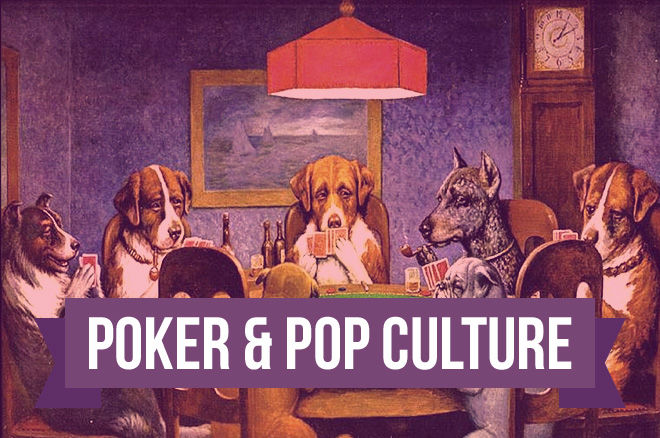
When asked to call examples of poker turning up in popular culture, a famous painting of a gaggle of dogs playing poker likely springs to mind as a primary choice for plenty of — even before W.C. Fields peering out from under the brim of his stovepipe hat over a poker hand or the chorus of "The Gambler" by Kenny Rogers.
Everyone knows it, that absurd gathering of various breeds smoking cigars, drinking whiskey and beer, and cards as if they were human. You do not also have to play poker to be accustomed to the poker-playing dogs, regarded by some because the epitome of kitsch or lowbrow culture, by others as an effective, insightful commentary at the middle and upper classes.
Even so, many do not learn about the origins of "Dogs Playing Poker" — nor that there wasn't only a single painting, but several of them. Let's delve slightly into these images of poker that can well rank some of the most familiar depictions of the sport ever produced by mainstream popular culture.
Calendars, Card-Playing Canines, and "Cash"
Cassius Marcellus Coolidge is the artist liable for the long-lasting paintings. Born in 1844 in upstate New York, Coolidge had already pursued multiple careers before creating the paintings for which he'd achieve his greatest fame, including turns as a faculty superintendent, a town clerk, and a small business owner. He'd even helped open and run a bank, a fitting occupation for somebody who during childhood picked up the nickname "Cash."
The moniker fit well with Coolidge's entrepreneurial streak, too, as he was involved throughout his life in various money-making schemes and concepts. Probably his best-known achievement not having to do with painting dogs was arising with the speculation for "comic foregrounds" — that is, those life-sized portraits with the faces cut out for individuals to stay their heads through to create funny photos.
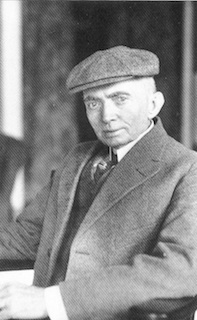 Cassius M. Coolidge
Meanwhile Coolidge additionally worked as a journalist, writing a column for which he drew his own illustrations. He even penned a comic book opera a few mosquito infestation in New Jersey titled King Gallinipper, once performed within the 1880s.
Along the best way Coolidge always painted and drew, successfully selling a lot of his illustrations to varied outlets. As early because the 1870s he had begun painting dogs, with a cigar company purchasing some to incorporate on their boxes. SOME OF THESE early depictions of dogs featured them adopting human poses, including one particularly from 1894 showing four St. Bernards playing poker. That one — simply titled "Poker Game" — would prove a precursor of more such paintings to come.
It was in 1903 — when Coolidge was nearly 60 — that he was hired by the Brown & Bigelow advertising firm to create a chain of oil paintings for use in calendars advertising cigars. Though just a fledgling company on the time, Brown & Bigelow would go directly to publish a lot of America's hottest calendars within the 20th century, starting from Norman Rockwell's famous Boy Scout calendars to these featuring Gil Elvgren's popular "pin-up" girls.
Coolidge ultimately produced 16 different paintings for Brown & Bigelow, all of which featured dogs engaged in various human activities. The calendars were a large hit, and in reality Coolidge was able eventually to sell the unique paintings for prices starting from $2,000 to $10,000.
Barking and Bluffing
Of the 16 paintings for the calendars, seven of them featured the dogs doing other non-poker things comparable to attending a baseball game, conducting a trial, playing pool, struggling over a broken down Model T, and celebrating New Year's Eve. The opposite nine all show them playing poker, and when regarded as a chain convey various scenarios and settings commonly related to our favourite card game.
The most renowned of the nine is "A CHUM in Need", the only featuring seven dogs closely gathered around a starkly-lit table studying their cards — and every other.
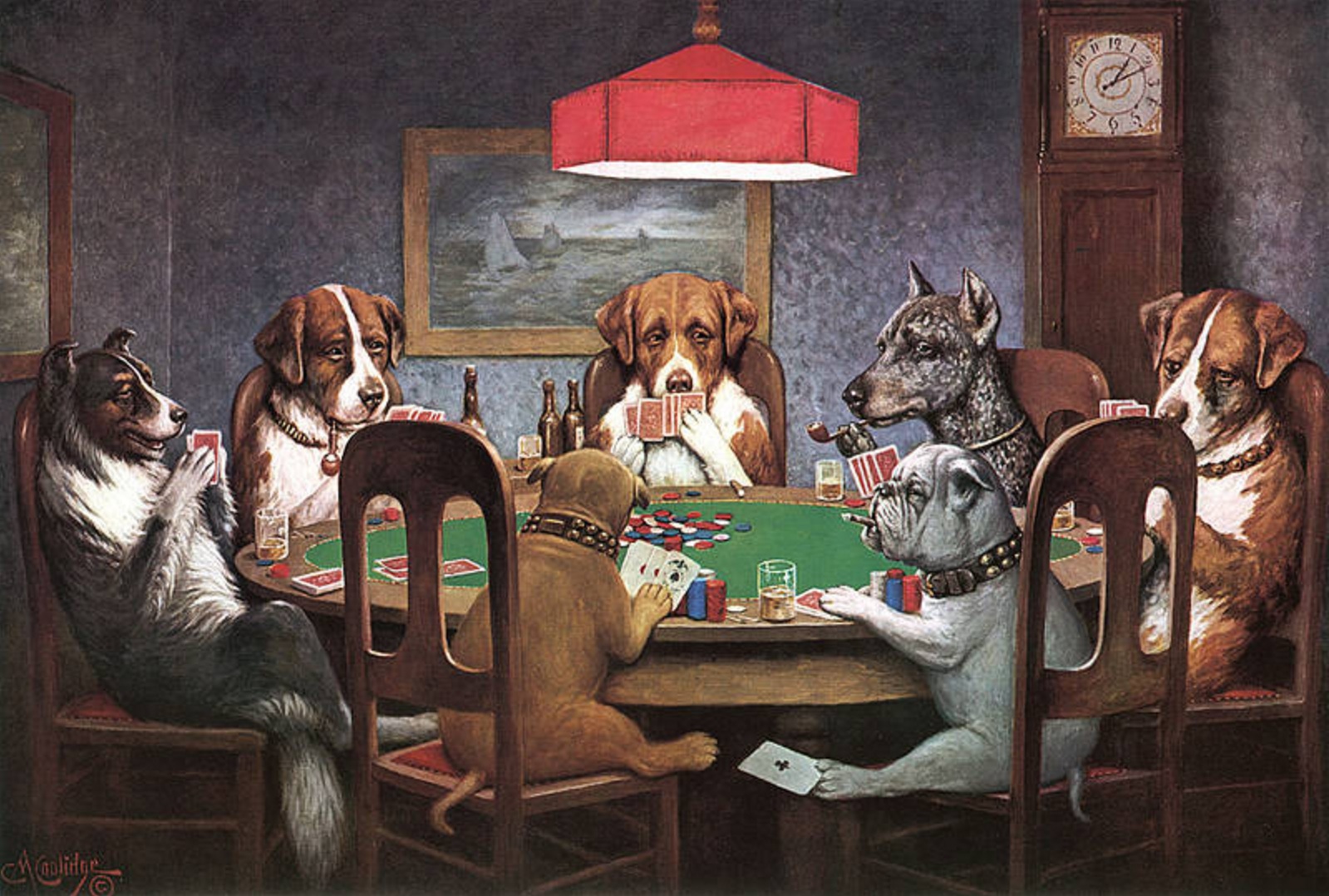 A Friend in Need (1903), Cassius M. Coolidge
Look closely and it's clear the sport isn't at the up-and-up. The cigar-chomping gray bulldog within the foreground is holding the ace of clubs in his extended paw under the table, apparently passing it to the tan-haired one on his left who looks to be holding the opposite three aces. Because the smallest dogs on the game, perhaps these two struck up an alliance for coping with their larger opponents.
Two of the paintings, "A Bold Bluff" and "Waterloo," tell a sequential story in a fashion that recalls the works of the good 18th-century artist William Hogarth.
In the primary ("A Bold Bluff"), a St. Bernard appears within the foreground at the left, a big tower of chips which he has presumably just pushed forward sitting within the center of the table before him. The opposite dogs take a look at him intently, but he gives away nothing behind the pair of spectacles resting on his snout.
Then within the second ("Waterloo"), his hand — a modest pair of deuces — have been revealed to the others. The St. Bernard grins as his paws rest at the large pile of chips he has just claimed, the opposite dogs registering various types of surprise and dismay, having fallen victim to the bold bluff.
For one of the crucial paintings, Coolidge moves the dogs' games to other locations. "His Station and 4 Aces" shows them playing on a train, with the dogs wearing an assortment of hats and coats suitable for travel. A conductor has interrupted the sport to tell an aghast-looking player the train as reached his stop. Bad timing — he has four aces! Another painting, "Stranger in Camp," finds the dogs at a campsite, apparently in conflict because the chips and cards are all scattered about with two of the players locked in what looks to be a pre-fight staredown.
"Poker Sympathy" shows a poor boxer falling back in his chair, his beer spilled and his four aces sliding off the table in line with seeing his opponent's straight flush. "Post Mortem" shows the cards stacked on table with just three dogs seated around it, still drinking, smoking cigars, and ostensibly discussing the night's activities. "Pinched with Four Aces" takes us back to the house game, this time being broken up by four dogs in police uniforms.
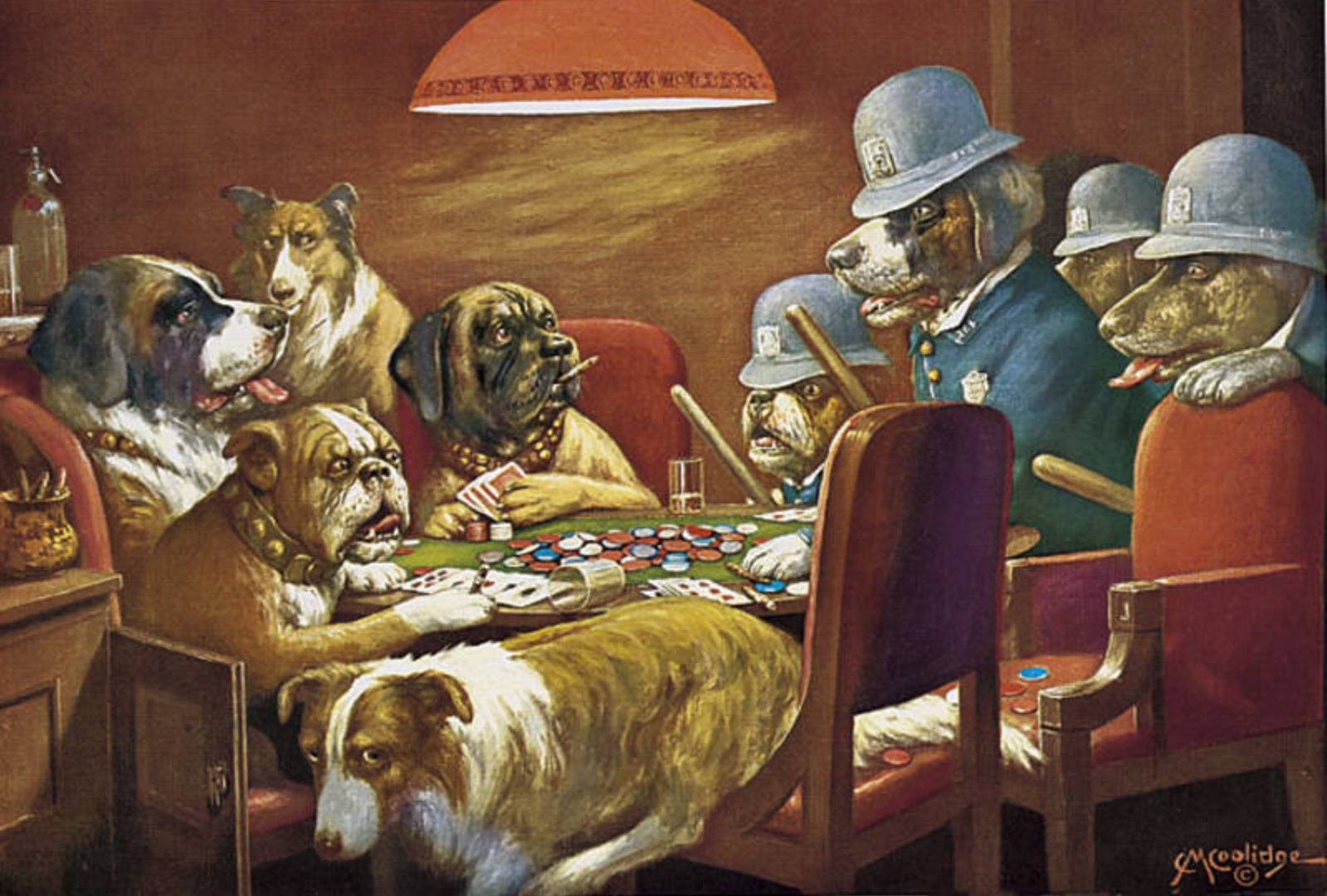 Pinched With Four Aces (1903), Cassius M. Coolidge
"Sitting Up with a Sick Friend" is the one some of the nine Brown & Bigelow paintings to add female dogs, so designated by their fashionable hats. Given the scene, the title appears to explain the lie told by the boys to the ladies in regards to the true nature in their gathering — a situation prefiguring the only within the 1912 film A Cure for Pokeritis. Probably the most female dogs has an umbrella raised as though to strike probably the most players, as a guilt-confirming playing card falls from the table within the foreground.
Finally in 1910 came one last painting featuring one more suspenseful scene from a personal game where a large bet was made and a table filled with dogs (including another female spectator) eye the bettor warily. The title of that you can refer both to the hand the bettor holds and his four similarly suspicious opponents — "LOOKS AS IF Four of a Kind."
It's a Dog-Eat-Dog World
All of those paintings — either collectively or singly — get commonly noted by the generic title "Dogs Playing Poker." Some of the various ideas they convey, they certainly help document how by the turn of the 20 th century poker had found its way from gaming dens, saloons, and steamboats into private homes. Poker had become a popular pastime enjoyed not only by outlaws and miscreants, but in addition by respectable "doctors" and "lawyers" (because the dogs appear to be).
It's worth noting to boot how the sector inhabited by Coolidge's dogs is decidedly male-dominated, again reinforcing poker's "masculine" subculture. As such, it somehow seems appropriate that Coolidge chose dogs to anthropomorphize in his paintings.
In a 2002 The big apple Times article, Coolidge's daughter, Gertrude Marcella Coolidge, then 92, tells how she and her mother preferred cats to dogs, and wonders what the paintings would has been like had her father gone in a special direction.
"You can't imagine a cat playing poker," she ultimately decides. "It doesn't appear to do."
Was it Coolidge's purpose to satirize male behavior as somehow animal-like? Or was his target much broader, meant to include the entire of the yank middle and upper classes and their foibles?
In Poplorica: A WELL-LIKED History of the Fads, Mavericks, Inventions, and Lore that Shaped Modern America, Martin J. Smith and Patrick J. Kiger speculate that Coolidge indeed intended the series as a satire. To support their argument they indicate how "A PAL in Need" uncannily echoes Georges La Tour's 17th-century painting "The Cheat with the Ace of Diamonds," a painting clearly intended to reveal" the ethical turpitude of the higher classes."
Does such an allusion indicate Coolidge was using a commercial medium to make an identical pronouncement about middle- or upper-class America? If he were, America doesn't appear to have minded very much.
Over the years the preferred paintings has been widely reproduced in plenty of media, including as posters, figurines, needlepoint kits, clocks, coasters, and, most suitably, at the backs of playing cards, let alone being frequently alluded to in countless other works of popular culture, including television shows, music, plays, films, or even video games.
At least a couple of a few of the upper class continue to love them to boot. At an auction in 2005, a personal collector from Ny city purchased the originals of "A Bold Bluff" and "Waterloo" for a groovy $590,400. Then last year the initial painting "Poker Game" sold in another auction for $658,000.
Talk about fetching numerous bones.
From the forthcoming "Poker & Popular culture: Telling the tale of America’s Favorite Card Game." Martin Harris teaches a course in "Poker in American Film and Culture" within the American Studies program at UNC-Charlotte.
Want to stick atop all of the latest within the poker world? If so, be sure to get PokerNews updates to your social media outlets. Follow us on Twitter and find us on both Facebook and Google+!
PokerNews.com is the world's leading poker website. Among other things, visitors will discover a daily dose of articles with the most recent poker news, live reporting from tournaments, exclusive videos, podcasts and such a lot more.
PokerStars is the biggest online poker room offering the largest amount of poker games and different game variations including Texas Hold'em, Omaha and other popular poker games. By joining PokerStars you'll be able to easily learn the entire poker rules and poker strategy by playing free poker games. Join PokerStars and revel in top of the range online poker.

Read More... [Source: PokerNews]
No comments:
Post a Comment